
Reviewed · GUIDED WALKS IN OSLO
Oslo Walking Tour with Audio Guide on your Smartphone
A phone-led walk that feels like Oslo stories. This is a smartphone audio tour that strings together the city’s best-known spots, from the bronze Tiger at Jernbanetorget to the Opera House and Akershus Fortress, with narration designed to keep you moving. I love the offline map and GPS route, because it lets you wander at your own speed without constantly checking your phone in circles. I also like the way the guide uses 25 audio recordings narrated by a professional historian, simple explanations, and light humor instead of a lecture.
The main thing to keep in mind: museum entry tickets are not included, so when a stop involves ticketed exhibits, you will need to plan those extra purchases in advance. This is also fully self-guided, meaning you bring your own headphones and actively follow the route in the app.
In This Review
- Why This Smartphone Audio Walk Works in Oslo
- Quick Hits Before You Start
- Tiger at Jernbanetorget: The Start of Oslo’s Big Personality
- Barcode Oslo: A City That Chose Bold Over Safe
- Munch Museum and the Oslo Opera House: Art Meets Waterfront Scale
- The Munch Museum, built for impact
- Oslo Opera House, where you can walk on the roof
- Gamle Logen: A Softer Stop Behind the Parliament
- Akershus Fortress: Max Manus, the Resistance Museum, and Stone Memory
- Max Manus
- Norges Hjemmefrontmuseum
- Christian IV’s Glove
- Oslo Cathedral and the Nordic Bible Museum: Faith, Art, and Text
- Oslo Cathedral, where ceremonies still matter
- Nordic Bible Museum, a niche stop done well
- The Mini Bottle Gallery: A Quick Laugh That Counts as Culture
- Karl Johans Gate to the Royal Palace: Oslo’s Main Spine
- Grand Hotel Oslo
- Norwegian Parliament, Stortinget
- Statue av Wenche Foss
- Oslo Royal Palace
- Oslo City Hall, Honnørbrygga, Nobel Peace Center, and Astrup Fearnley
- Oslo City Hall
- Honnørbrygga
- Nobel Peace Center
- Astrup Fearnley Museum
- Price, Time, and What You Actually Get for $8.46
- Who This Oslo Audio Tour Fits Best
- Should You Book It?
- FAQ
- What is the duration of the Oslo Walking Tour with Audio Guide?
- Where does the tour start and end?
- Is there an in-person guide?
- What devices and languages are supported?
- Do I need headphones?
- Are museum entry tickets included in the price?
- Is the route navigation available offline?
- How many audio recordings are included?
- Can I access the audio guide later after booking?
- What time of day can I take the tour?
Why This Smartphone Audio Walk Works in Oslo

Oslo is a city where the highlights are close enough to string together, but spread out enough that a normal group tour can feel rushed. This walk leans into that reality. You start at the Tiger at Jernbanetorget, then work your way through the central-core sights and the waterfront areas, with the audio cueing you when to look up, slow down, or stop for photos.
At a cost of $8.46 per person for about 3 hours, the value is mainly in the storytelling and route help. It is not paying for a person to lead you. It is paying for a historian-led tour you can pause, rewind, and split into chunks whenever your legs, weather, or snack timing asks you to.
And yes, Oslo can be windy near the harbor, so having an app route matters. You can keep your eyes on the sights, not on maps.
Quick Hits Before You Start
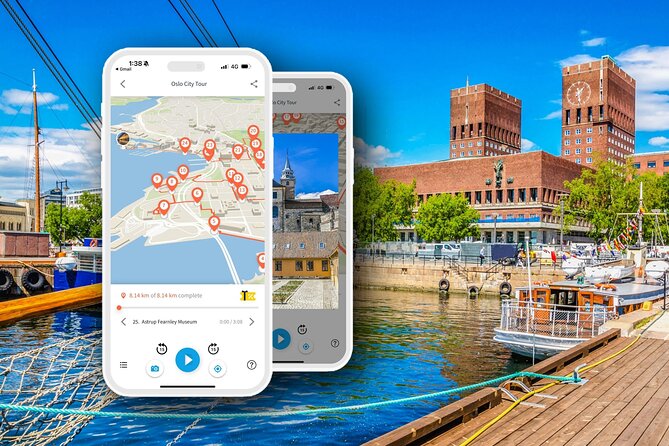
- Offline route guidance: you get a map with a planned path for easy GPS navigation.
- Historian narration in plain English: 25 recordings with light, non-lecture pacing.
- A tight set of iconic stops: Tiger at Jernbanetorget, Barcode, Munch, Opera House, Akershus, and more.
- Free sights mixed with ticketed museums: lots of exterior viewing is included, but some museums require tickets.
- Built for self-control: I like that you decide when to pause for photos, coffee, or just a breather.
- Long access window: you get one-year access in your preferred language, and the audio can be accessed anytime.
Tiger at Jernbanetorget: The Start of Oslo’s Big Personality
Your walk kicks off at Tigeren pa Jernbanetorget, the bronze Tiger outside Oslo Central Station. It is not just a quirky sculpture. The story behind it is part of what makes the beginning fun: the tiger was gifted in 2000 to mark Oslo’s 1000th anniversary, and it has become a playful meeting point for travelers.
I like starting here because it immediately gives you a mental frame for Oslo. The nickname Tigerstaden, tied to poet Bjørnstjerne Bjørnson, plays with the city’s reputation for danger, then flips it into something more confident. When your audio cues you to look at the tiger’s placement and how people interact with it, you understand it as a symbol of energy, not just a landmark.
Practical note: this is a great spot to orient yourself, grab water, and get ready for the water and museum cluster later.
More Guided Walks in Oslo


Barcode Oslo: A City That Chose Bold Over Safe
Next comes Barcode Oslo, the set of modern high-rises along the Bjørvika waterfront. From a distance, the buildings resemble the lines of a barcode. Up close, it is a lesson in how Oslo reinvented its skyline starting in the 2000s.
I like this stop because it forces you to notice contrast. Oslo is often described through its classic center and royal institutions, but Barcode makes the argument that the city also moves forward with glass, steel, and architectural confidence. The audio helps you read what you are seeing instead of just thinking it looks futuristic.
If you dislike modern architecture, you might still enjoy this for the viewpoint alone. If you like it, this is one of the fastest ways to “get” the Oslo that locals debate, not just the Oslo that postcards repeat.
Munch Museum and the Oslo Opera House: Art Meets Waterfront Scale
The route includes two major Bjørvika-area moments: The Munch Museum (MUNCH) and the Oslo Opera House.
The Munch Museum, built for impact
The Munch Museum opened in 2021 in a dramatic waterfront tower. It holds over 26,000 works donated by Edvard Munch, including versions of The Scream, Madonna, and The Dance of Life. This is more than ticket-and-frames. The building shape and the way the museum presents the art make it feel intense from the first minute.
One caution: museum entry is not included. If Munch is your top priority, check ahead for ticket timing so you do not lose your place in the walk.
More of Norway between waymarks, on foot:
- Taste of Oslo Walking Tour
★ 4.5 · 282 reviews - Central Oslo Guided Walking Tour with Local Guide
★ 4.5 · 278 reviews - Oslo: Private Walking Tour with a Local
★ 4.5 · 263 reviews - Oslo: Snowy Forest Torchlight Walk with Campfire
★ 4.6 · 254 reviews
Oslo Opera House, where you can walk on the roof
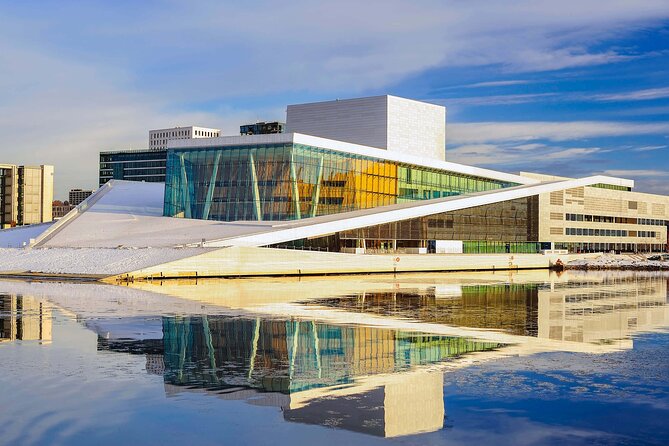
Even without going inside, the Opera House is worth the stop. Opened in 2008 and designed by Snøhetta, it is known for its angled, white marble roof that people can walk onto like a public terrace. That design matters for this tour because you can enjoy the landmark even if you skip an indoor visit.
Inside, you will find performances of opera and ballet, with oak and glass playing a big role. For this audio walk, though, the outdoor experience is already strong: big angles, bright light, and wide views across the harbor.
Gamle Logen: A Softer Stop Behind the Parliament
Then you move toward Gamle Logen, the Old Lodge built in 1836 as a Masonic hall, later turned into a music and culture venue. Its Neoclassical façade and decorated concert hall make it feel more intimate than the bigger headline buildings.
I like Gamle Logen for two reasons. First, it slows your pace right after the big, modern Bjørvika hits. Second, it gives you a reminder that Oslo’s cultural life is not only about museums and royal sites. It is also about performance spaces tucked into everyday streets.
This is one of those stops where the audio helps you notice details you might otherwise pass.
Akershus Fortress: Max Manus, the Resistance Museum, and Stone Memory
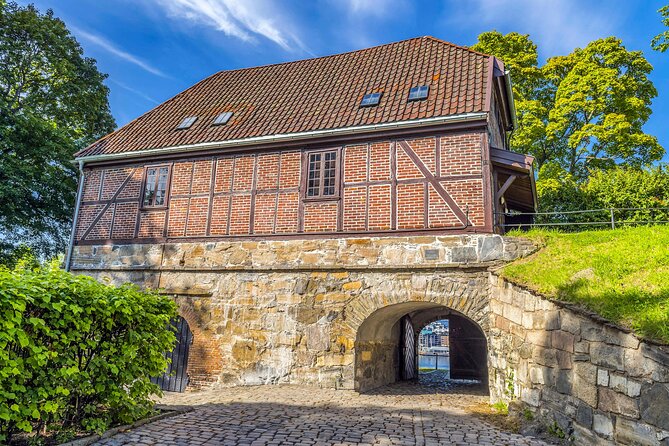
The walk really turns historic at Akershus Fortress. This medieval stronghold, built in the late 1200s, was used as a royal residence, later as a prison and military base. During World War II, it also became a Nazi prison. The setting alone makes the stories hit harder than you might expect.
The tour spotlights several linked stops around the fortress, including:
Max Manus
You get the Max Manus statue near Akershus Fortress, unveiled in 2011. The bronze figure shows Manus mid-stride, coat flaring, focused rather than posed as a victory monument. The backdrop matters here too, since the harbor view connects the statue to the kind of daring resistance work people associate with him.
Norges Hjemmefrontmuseum
Inside the fortress walls is the Norwegian Resistance Museum, the Norges Hjemmefrontmuseum. The museum tells the clandestine struggle against Nazi occupation from 1940 to 1945 using original artifacts, documents, photographs, and immersive storytelling. It is dimly lit and quiet in tone, aimed at showing how bravery happened in everyday actions like sabotage missions, underground presses, and coded messages.
This is a ticketed stop in the practical sense, even if you can still walk through the fortress grounds. If you want the full experience, you should plan your museum time and ticket purchase.
Christian IV’s Glove
Another tiny stop that the audio makes easy to catch is Christian IV’s Glove. It is a metal glove embedded in the stone wall, tied to legend that King Christian IV dropped his glove during a visit in the 17th century, then left it as a symbol of presence. It sounds whimsical, and it is, but it also reads like a human footnote to power.
I love these short legends inside larger historic settings. They add personality without changing the gravity.
Oslo Cathedral and the Nordic Bible Museum: Faith, Art, and Text
As you work back toward the city center, the tour includes Oslo Cathedral (Oslo Domkirke) and the Nordic Bible Museum (Nordisk Bibelmuseum).
Oslo Cathedral, where ceremonies still matter
Oslo Cathedral was consecrated in 1697. The audio frames it as both Baroque grandeur and Scandinavian restraint, with frescoes and an altarpiece that draw your eye upward. It also includes 20th-century stained glass by Emanuel Vigeland.
If you enjoy places where history still functions, the setting matters. The cathedral is tied to coronations, royal weddings, and vigils, and the square around it hosts everyday public life. In the audio tour format, the cathedral stop is often where you slow down and just look.
Nordic Bible Museum, a niche stop done well
The Nordisk Bibelmuseum opened in 2018 and focuses on over 5,000 Bibles in more than 1,500 languages, including items linked to early printing like a page from a Gutenberg Bible and early Scandinavian translations.
This is one of those museums you might not pick on your own, and that is exactly why it works on a walking tour. The themes are bigger than religion alone. The audio helps you connect printing, language, and how texts shaped cultures over time, including through illuminated manuscripts, tiny pocket Bibles, and even Bible comics.
Ticket note: museum entry is not included, so decide if you want to add this indoor time.
The Mini Bottle Gallery: A Quick Laugh That Counts as Culture
Next you pass The Mini Bottle Gallery, devoted entirely to miniature bottles. It was founded by collector Christian Ringnes and houses over 53,000 tiny bottles, ranging from vintage liquor miniatures to odd novelty shapes like animals, skulls, or body parts.
This stop is short in your walking time, but it changes the emotional tempo of the tour. After fortress stories and cathedral art, this is a reset. The audio makes the weirdness understandable, so it does not feel random.
Bring a curious mood. If you like offbeat museum concepts, you will enjoy this one.
Karl Johans Gate to the Royal Palace: Oslo’s Main Spine
Now you hit Karl Johans gate, the main boulevard running from Oslo Central Station toward the Royal Palace. The audio treats this street like a living spine, with institutions and everyday movement side by side: Parliament, National Theatre, universities, cafés, shops, and street performers.
This is a great section for your pace to match your interests. If you want more photo stops, you have them. If you want to keep walking, the audio still gives you context without forcing long pauses.
Key stops you will encounter along this stretch:
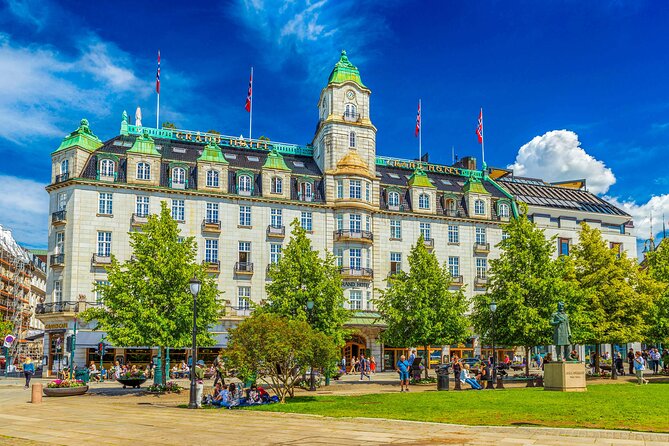
Grand Hotel Oslo
The Grand Hotel opened in 1874 and faces Karl Johans gate. It has a famous guest and event story line tied to Nobel Peace Prize laureates and Henrik Ibsen, plus a rooftop bar with city views. In this tour format, it is mostly a look and a story moment, not a full stay.
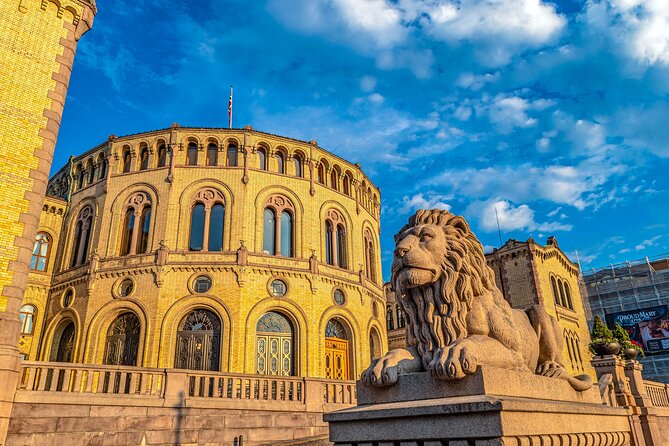
Norwegian Parliament, Stortinget
The Stortinget building, completed in 1866, sits at the heart of the boulevard. The audio helps you see it as modest compared to some grand European parliaments, while still clearly signaling purpose. Outside, it is also the place for demonstrations and civic moments.
Statue av Wenche Foss
Near the National Theatre is the Statue av Wenche Foss, unveiled in 2007. It honors the actress and cultural figure known for stage presence, disability rights advocacy, and sharp wit. Even if you do not know her work, the story gives the statue meaning beyond a name on a plaque.
Oslo Royal Palace
At the western end is the Oslo Royal Palace (Det Kongelige Slott), completed in 1849 and still an official residence and working royal office. The palace grounds are open year-round, and in summer you can tour the gilded halls. The audio also points out the feel of the changing-guard moment, and it is an easy way to make the final stretch memorable without spending money.
Oslo City Hall, Honnørbrygga, Nobel Peace Center, and Astrup Fearnley
The tour finishes with a strong run of harbor-side landmarks.
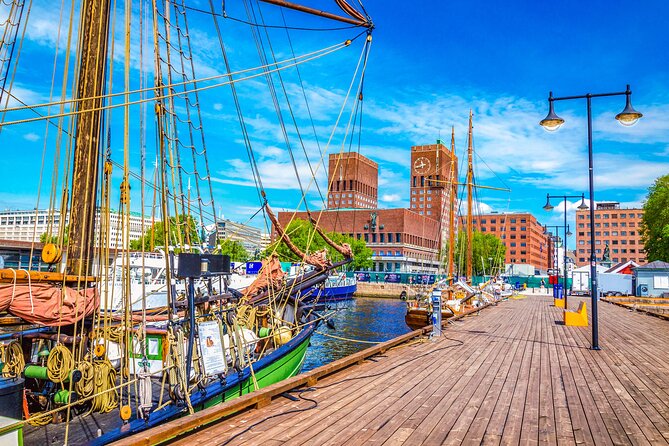
Oslo City Hall
Oslo City Hall (Rådhuset) is bold and instantly recognizable, with brick, two towers, and murals. It was completed in 1950 and serves as the seat of city council. It is also where the Nobel Peace Prize ceremony happens each December.
I like this stop for contrast. It is not royal, not medieval, not modern glass. It feels like national identity told in everyday civic language, and the waterfront square makes it feel open and public.
Honnørbrygga
Right in front is Honnørbrygga, the Pier of Honor. It is a modest wooden pier used for ceremonial arrivals of royalty and state guests. Even if you do not attend an event, the audio makes you imagine the timing and weather of those arrivals. It turns a simple pier into a story point.
Nobel Peace Center
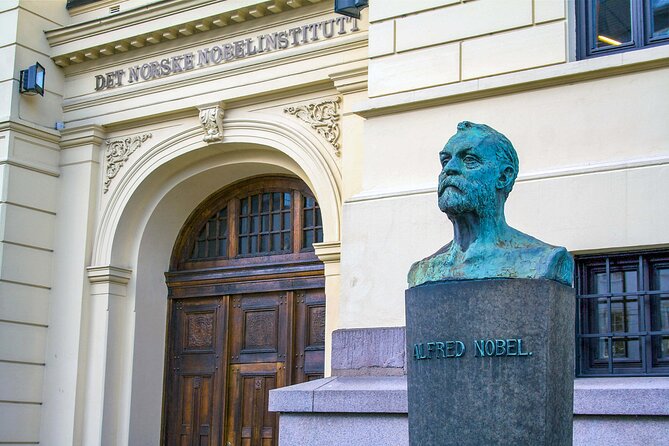
The Nobel Peace Center is housed in a former train station by Oslo’s harbor. The audio frames it as interactive exhibits focused on the Peace Prize laureates and how their work connects to ideas like justice and reimagining peace. It is not presented like a trophy room.
Ticket note again: you will likely want to decide in advance whether you want to go in, since museum entry is not included.
Astrup Fearnley Museum
Finally, the Astrup Fearnley Museum is positioned on the Tjuvholmen waterfront, designed by Renzo Piano and opened in 2012. The building itself is part of the attraction, with sail-like curves and lots of glass. Inside are contemporary works by artists like Damien Hirst, Jeff Koons, and Cindy Sherman.
If you are interested in architecture and modern art, this ending feels purpose-built. If you prefer quieter stops, you can still enjoy the exterior and the setting, then decide how much indoor time you want.
Price, Time, and What You Actually Get for $8.46
At $8.46 per person, you are paying for:
- 25 historian-led audio recordings
- an offline GPS map route
- landmark illustrations
- one-year access to the tour in your language
You are not paying for:
- a live in-person guide
- smartphone and headphones
- transport
- food and drinks
- museum entry tickets
That means the real value depends on how you use it. If you plan to walk the full outdoor route and enjoy free viewing moments at the Opera House roof, fortress grounds, City Hall area, and the palace exterior, this feels like a budget-friendly way to understand Oslo. If you plan to enter every museum on the route, you will add ticket costs, so your final budget will rise. Still, you would be spending that money anyway once you decide you want the indoor experiences.
Duration is listed at about 3 hours, which is a good amount of time for a focused highlights loop without turning the day into a long haul.
Who This Oslo Audio Tour Fits Best
This self-guided format is a strong match if:
- you want flexibility to pause for photos, snacks, or just to stand and watch
- you like learning in a simple, story-driven way rather than a formal group lecture
- you prefer exploring on your own timing instead of matching a schedule
It may be less ideal if:
- you want a human guide to answer questions on the spot
- you want everything included, since museum entry tickets are separate
- you do not like using phones outdoors, since you will need to follow the app map and narration
Should You Book It?
I would book this if you want an efficient, story-first walk through Oslo’s core highlights and you are comfortable using your phone with the audio app and offline map. It is good value for the narration quality and the way it connects places like the Tiger at Jernbanetorget, Akershus Fortress, and Karl Johans gate into one readable route.
Skip it only if you are looking for a guided group experience with included museum tickets and transport. This tour gives you freedom, not a schedule-managed escort. And in a city like Oslo, that freedom is often the point.
FAQ
What is the duration of the Oslo Walking Tour with Audio Guide?
The tour is listed at about 3 hours.
Where does the tour start and end?
It starts at The TigerJernbanetorget, 0154 Oslo, Norway and ends back at the same meeting point.
Is there an in-person guide?
No. This is a self-guided audio tour, so you follow the route using the app map.
What devices and languages are supported?
The audio guide app works on iPhone and Android, and the tour is offered in English.
Do I need headphones?
Yes, headphones are not included, so you should bring your own.
Are museum entry tickets included in the price?
No. Entry tickets to museums are not included and must be purchased separately in advance.
Is the route navigation available offline?
Yes. You get an offline map featuring a route for GPS navigation.
How many audio recordings are included?
The tour includes 25 audio recordings narrated by a professional historian.
Can I access the audio guide later after booking?
Yes. You get one-year access to the tour in your preferred language, and the audio guide can be accessed at any time.
What time of day can I take the tour?
The listed opening hours run Monday through Sunday, 7:00 AM to 8:00 PM.
Cairn to Cairn
- Oslo To Bergen Self-Guided Full Day Trip with Flåm Railway And Fjord Cruise★ 4.0 · 69 reviews
- Self-Guided 22-Hour Round Trip From Oslo To Sognefjord With Flåm Railway★ 4.5 · 54 reviews
- Oslo Self Guided Walking Tour with an APP★ 4.5 · 19 reviews
- Oslo Viking Quest: Exploration Game and Tour★ 4.5 · 17 reviews
More Audio Tours in Oslo
- Oslo: Scenic Fjord Cruise with Audio Guide Commentary★ 4.5 · 5,375 reviews
- Downtown Oslo: Self-Guided Highlights and History Audio Tour★ 4.0 · 10 reviews
- Akerselva River Meander: A Self-Guided Audio Tour★ 3.5 · 8 reviews
- Oslo Scavenger Hunt and Highlights Self Guided Audio Tour★ 4.5 · 6 reviews
Newly marked on the map for Oslo
- Oslo: WWII History Private Walking Tour★ 5.0 · 1 review
- Oslo: All-Inclusive Self-Guided Kayaking & Camping Adventure★ 5.0 · 1 review
- Stand up paddleboard adventure in Leangbukta★ 5.0 · 1 review
- Kayak and Canoe Tour in Lake Bogstad★ 5.0 · 1 review
- Oslo All Inclusive Private Walking Tour★ 5.0 · 1 review
- Sightseeing Private Tour of Oslo and Viking Ship Museum★ 5.0 · 1 review
- 3days tour to Flåm-næroyfjord(or Preikstolen Hiking)-Bergen★ 5.0 · 1 review
- Departure Private Transfer from Oslo City to Oslo Airport OSL by Luxury Van★ 5.0 · 1 review
Guided Walks in Oslo, compared.
Guided Walking Tour of Central Oslo with Local Guide
Read our review →


Central Oslo Guided Walking Tour with Local Guide
Read our review →


Browse the lists this tour appears in