

Reviewed · GUIDED WALKS IN OSLO
Central Oslo Guided Walking Tour with Local Guide
Oslo feels like it runs on stories. This guided walk gives you the main ones fast, with stops built around the city’s landmarks and civic power. You’ll see the Tiger Sculpture that helped earn Oslo the nickname Tiger City, then move through the core around the Opera House, Parliament, and the Royal Palace.
I like that the tour is tight and well-paced for 2 hours. I also like that it stays practical, with no need to buy separate admissions for the viewing stops.
The one thing to keep in mind is that this is a walking route with lots of city blocks, and it does not include visits inside buildings. If you want long museum time, this is not that kind of tour.
In This Review
- Key things to know before you go
- Why This Central Oslo Walk Works So Well for a First Day
- Meeting at TigerJernbanetorget, Then Warming Up With the Tiger Sculpture
- Rådhusgata and Oslo City Hall, Where the City Talks Back
- Akershus Fortress Time: Medieval Defense Without a Full Interior Visit
- Opera House, Oslo Cathedral, and the Contrast of Architectural Styles
- Karl Johans Gate to Aker Brygge: From Main Street to Waterfront Energy
- Storting and the Royal Palace Finish: Democracy to Royal Views
- How the Guides Make It Feel Like Oslo, Not a Checklist
- Practical Tips: Weather, Walking Pace, and What to Wear
- Who This Oslo Walking Tour Is Best For
- Should You Book This Central Oslo Guided Walking Tour?
- FAQ
- How long is the Central Oslo Guided Walking Tour?
- What is the price per person?
- What language is the tour offered in?
- Where does the tour start and end?
- Does the tour include visits inside buildings?
- How large is the group?
- What if the weather is poor?
Key things to know before you go
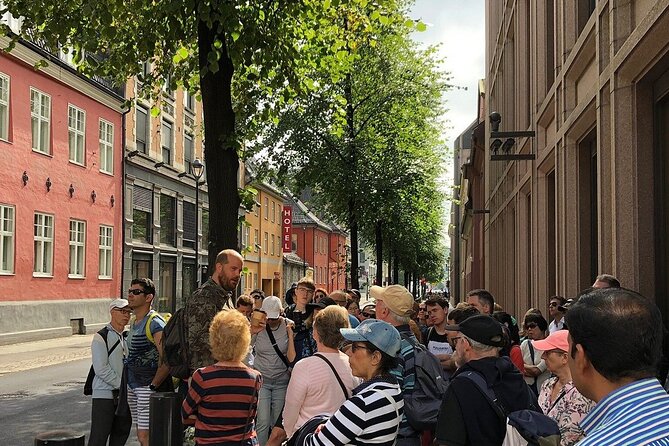
- TigerJernbanetorget start, ending at the Royal Palace, so you finish with a classic Oslo photo moment
- Tiger Sculpture stop ties directly to Oslo’s millennium-era nickname story
- Major civic sights in one loop: City Hall, Parliament (Storting), and the Cathedral
- Opera House waterfront views without the hassle of a building visit
- Small enough group to stay together (max 27), typically in English with a mobile ticket
Why This Central Oslo Walk Works So Well for a First Day
If you’re trying to get your bearings in Oslo, this tour is a smart shortcut. In about two hours, you cover the center where a lot of the city’s identity is on display. It is guided, in English, and built for people who want context without spending the whole day planning routes.
At $16.94 per person, the value comes from what you get for the money: a local guide for a concentrated hit of history and culture, plus a route that links landmarks logically. You are not paying for a pile of museum tickets. You’re paying for interpretation, timing, and a walk that makes the city feel less random.
One other reason this works: the itinerary is built from widely recognized landmarks, but it also includes the in-between streets that connect them. That helps you understand how Oslo is laid out, not just what it looks like in postcards.
Meeting at TigerJernbanetorget, Then Warming Up With the Tiger Sculpture
You start at TigerJernbanetorget (Jernbanetorget square). The first stop is the Tigeren pa Jernbanetorget, the famous Tiger Sculpture. It was erected in 2000 to mark Oslo’s millennium, and it is the literal symbol behind Oslo’s “Tiger City” nickname.
This works as a warm-up stop because you get instant payoff without effort. Ten minutes here is enough to notice the scale, take photos, and understand why the tiger shows up in the city’s identity. If you want a quick mental map for later, this is it.
Practical note: the tour listing says admissions for this stop are free. So you can focus on the walk and the story, not ticket math.
More Guided Walks in Oslo



Rådhusgata and Oslo City Hall, Where the City Talks Back
After the tiger, the route heads toward Rådhusgata, a historic street dating back to the 1620s. This is the kind of street you might otherwise speed past, but with a guide you learn how central it is to Oslo’s civic layout. You are basically getting an urban timeline, street by street, from old central development to modern administration.
Next comes Oslo City Hall. The building you’ll see was constructed from 1931 to 1950, and it is known for hosting the annual Nobel Peace Prize ceremony. Even from the outside, it helps to know what you are looking at. You can connect the building to one of Norway’s most famous global roles, which makes it feel more than just another grand façade.
The tour allows about 15 minutes for this area. That is enough time to slow down, look up at details, and ask questions before moving on.
Akershus Fortress Time: Medieval Defense Without a Full Interior Visit
Then you shift to Akershus Fortress, a medieval site built to protect Oslo from invasions. Construction dates to the late 1200s, around 1299, and the fortress has served as a military base, prison, and later a museum and historical site.
Here is the key practical reality: this tour is primarily a street and exterior viewing experience. The tour notes that it does not include visits inside buildings. So plan to experience Akershus Fortress mainly through the vantage points you get while walking the route and stopping at key areas.
For me, that can still be satisfying. A fortress is designed to be read from its position. You get the sense of purpose by seeing how it sits and how the surrounding city behaves around it. If you want deeper interior interpretation, you’d pair this tour with a separate museum time later.
Opera House, Oslo Cathedral, and the Contrast of Architectural Styles
The route includes two big visual anchors that show how Oslo balances old and new.
First, there is the Oslo Opera House. It is a contemporary architecture icon, completed in 2008. It serves as the home of the Norwegian National Opera and Ballet, and it is famous for its waterfront location. On a walking tour, this stop is less about ticketed access and more about seeing the building’s relationship with the harbor edge. You can appreciate why the structure became a landmark.
Then you move to the Oslo Cathedral. The original church dates to 1697, and it is known for Baroque architecture. It underwent renovations, including in the 20th century, and it continues to serve as a cultural and religious site.
The good thing about pairing these two stops is that they make Oslo’s architecture feel like a conversation, not two unrelated categories. One is modern and playful with space and public presence. The other is formal, traditional, and tied to centuries of worship and civic life.
More of Norway between waymarks, on foot:
- Taste of Oslo Walking Tour
★ 4.5 · 282 reviews - Oslo: Private Walking Tour with a Local
★ 4.5 · 263 reviews - Oslo: Snowy Forest Torchlight Walk with Campfire
★ 4.6 · 254 reviews - Oslo Grünerløkka Food & Culture Walking Tour
★ 4.5 · 230 reviews
Karl Johans Gate to Aker Brygge: From Main Street to Waterfront Energy
Next up is Karl Johans gate, Oslo’s main street. It runs from the Royal Palace to Oslo Central Station and was established in the 19th century. This street is where you’ll find historic buildings, shopping, dining, and the everyday flow that makes the capital feel like a lived-in place.
The tour gives you about ten minutes here, which is perfect for two things:
1) realizing how central the street is for future plans
2) seeing the rhythm of the city without turning it into a long shopping detour
After that, you reach Aker Brygge, the popular waterfront shopping, dining, and entertainment district. It began as a shipyard in 1854, then transformed into its modern form in the 1980s. That history matters. It explains why the harbor area feels built for public movement, with an urban energy that does not pretend to be medieval or distant.
Aker Brygge is also a great place to pause your own schedule. If you still have energy after the tour, it’s an easy spot to grab a meal, browse, or just watch the waterfront life.
Storting and the Royal Palace Finish: Democracy to Royal Views
Toward the end, the route visits the Storting building, the seat of the Norwegian Parliament. It was constructed between 1861 and 1866, and the architecture signals legislative authority and democratic values.
Seeing Storting during a walking tour is useful because you understand it as part of a central corridor, not a distant destination. It also helps you connect Norway’s national governance to the same city blocks you’ve been walking the whole time.
Finally, the tour ends in front of the Royal Palace, at Slottsplassen 1. This finish is deliberate. You get a classic Oslo anchor, the kind of landmark you can use to orient yourself for the rest of your trip. If you plan to explore more neighborhoods afterward, your end point gives you a clear starting compass.
How the Guides Make It Feel Like Oslo, Not a Checklist
The biggest praise for this tour is the guide experience. The route is standard enough, but what makes it work is how the guide tells the story and keeps it conversational.
You may encounter guides with names like Suzanne, Alexia, Marta, Camille, Kamil, Daniel, and Ann. The common theme in what people liked is not just facts. It’s pacing, humor, and the ability to handle questions, even with a bigger group. One person highlighted that the guide kept everyone together and made sure the group could hear well. Another noted a portable speaker system helps with city noise.
Here’s what that means for you. If you’re the type who likes asking why something exists, what it replaced, or how Norway thinks about its public spaces, this format is a good fit. If you want a quiet, museum-like experience with no interaction, a group walking tour might feel too social.
Group size can also influence comfort. The tour caps at 27. That’s not huge, but some people do prefer smaller groups for audio clarity and room to stop and look around.
Practical Tips: Weather, Walking Pace, and What to Wear
This tour works best when the weather cooperates. The experience states it requires good weather, and if it is canceled due to poor weather, you get an alternative date or a full refund.
So come prepared. Oslo weather can change fast, and a rain layer is a lifesaver. Wear comfortable shoes. Even if the pace feels manageable, you will cover multiple city blocks.
Also, plan for an outside-focused route. Since visits inside buildings are not included, bring patience for scenic stops and photo moments from sidewalks, plazas, and waterfront edges. You’ll still get a lot out of it, but your time will be spent looking outward.
Finally, it is near public transportation, which helps if you want to start early and then hop to other parts of the city right after.
Who This Oslo Walking Tour Is Best For
This is a strong choice if you want an efficient orientation to central Oslo. I especially like it for:
- First-time visitors who want a map of the city’s main power centers
- People who like architecture and civic landmarks but do not want museum ticket time
- Families and mixed-age groups, since the tour is short enough to keep motivation up (and the pace is generally designed for a guided walk format)
It is also a solid pick if you love history, but your priority is the streets and the meanings behind places rather than deep museum immersion.
If you are limited on walking distance, you might find it challenging since it covers many blocks. In that case, consider whether you can comfortably do a two-hour walk with frequent stops.
Should You Book This Central Oslo Guided Walking Tour?
Yes, I think you should book this tour if you want a practical first-day overview and you like learning while you walk. The price is reasonable, and the route covers landmarks that help you understand how Oslo works, from Tiger City branding to Parliament and palace views.
Book it especially if:
- you arrive in Oslo and need your bearings fast
- you want a guided explanation of what you are seeing at the Opera House, City Hall, and Akershus area
- you prefer a short, structured walk over a long museum day
Pass or consider alternatives if:
- you need inside building visits as the main event
- you want a small-group experience for maximum personal space and audio clarity
- you cannot manage a two-hour walking route over central streets
If you’re planning your first hours in Oslo, this is a smart way to turn a blank map into something you actually understand.
FAQ
How long is the Central Oslo Guided Walking Tour?
The tour lasts about 2 hours.
What is the price per person?
The price is $16.94 per person.
What language is the tour offered in?
The tour is offered in English.
Where does the tour start and end?
It starts at TigerJernbanetorget, 0154 Oslo, Norway, and finishes in front of the Royal Palace (Slottsplassen 1, 0010 Oslo, Norway).
Does the tour include visits inside buildings?
No. The tour does not include visits inside any buildings.
How large is the group?
The tour has a maximum of 27 travelers.
What if the weather is poor?
The tour requires good weather. If it is canceled due to poor weather, you will be offered a different date or a full refund.
Newly marked on the map for Oslo
- Oslo Scavenger Hunt and Highlights Self Guided Audio Tour★ 4.5 · 6 reviews
- Oslo easy walk★ 5.0 · 7 reviews
- Oslo: Oslofjord Electric Boat Cookie Cruise★ 3.8 · 7 reviews
- Oslo City Walks: The City of Contrasts★ 3.4 · 7 reviews
- The Oslo Beer Adventure★ 1.9 · 7 reviews
- 7-Day Scenic Scandinavian Tour from Oslo exploring Denmark, Sweden and fjords in Norway★ 4.5 · 7 reviews
- Private Oslofjord Island Hopping Tour★ 4.5 · 8 reviews
- Free Oslo Photo Tour: Iconic & Instagrammable Spots★ 5.0 · 8 reviews
Guided Walks in Oslo, compared.
Guided Walking Tour of Central Oslo with Local Guide
Read our review →




Browse the lists this tour appears in