
Reviewed · GUIDED WALKS IN OSLO
Myths and Legends: An Oslo Walking Discovery
Ghost stories meet real street corners. This Oslo walking tour ties myths and legends to Viking beliefs, superstitions, and the city’s landmark architecture.
I love that it is a tight route with timed stops, so you see a lot without it dragging. I also love the storytelling angle, including clear, funny explanations in English, and strong moments at Akershus Castle and Oslo Cathedral.
One possible drawback: this is more folklore and mystery than full-on scary. If you want a dark, horror-style vibe, you may find the tone lighter than expected, and the pacing can feel quick at times.
In This Review
- Key Things to Know Before You Walk
- Why Oslo’s Myths Feel Personal on Foot
- Timing, Group Size, and Walking Comfort (What to Expect)
- Oslo City Hall: Vikings, Beliefs, and a Worldview Outside the Doors
- Christiania Torv: Ghostly Apparitions and Superstition as Protection
- Akershus Castle and Fortress: The 13th-Century Architecture That Anchors the Legends
- Kvadraturen Neighbourhood: Medieval and Classic Oslo in One Breath
- Oslo Cathedral on Stortorget: Baroque Decorations and Spires Against the Sky
- Price Value: Is $42.98 Worth a Myth-Heavy Evening Walk?
- Who Should Book This Oslo Myth and Legends Walk?
- Should You Book This Tour?
- FAQ
- How long is Myths and Legends: An Oslo Walking Discovery?
- What time does the tour start?
- Where do I meet the guide, and where does the tour end?
- Is the tour offered in English?
- What is the price per person?
- Is admission included?
- Are all stops indoors?
- What group size should I expect?
- Can I cancel for a full refund?
Key Things to Know Before You Walk
- A 2-hour loop built around timed stops (15, 20, 50, 20, 15 minutes) so you stay in motion.
- English guidance that is easy to follow, with guides like Marija and Ihor highlighted for their storytelling.
- Akershus Castle and Fortress time is the long stop, with free admission listed for the experience.
- Outside-only segments at Oslo City Hall and Oslo Cathedral, so you get the atmosphere without ticket hassle at those points.
- Max group size of 16, which helps you hear the guide and ask questions as you go.
Why Oslo’s Myths Feel Personal on Foot

There is a reason this kind of tour works in Oslo: the city is built in layers. You move from Viking-era ideas to medieval streets, then land at Baroque and more formal architecture, all while the guide keeps connecting the stories to the actual stones.
This is not about pretending ghosts are real. It is about how people once used stories to explain the world, manage fear, and make sense of luck and danger. When you stand in the right spot, you start to see why a “ghost story” could become a local survival tool, not just entertainment.
The best part is the balance. You get wonder and humor, with just enough spine-tingle to make you look around more closely at buildings, squares, and street corners.
Timing, Group Size, and Walking Comfort (What to Expect)
This tour runs about 2 hours, starting at 6:00 pm. The timing is strict enough to keep momentum, with the route broken into five focused segments, so you should expect to walk continuously between stops.
You will be in a small group, up to 16 travelers. That matters because the experience is story-driven, and smaller groups usually mean better flow and fewer people talking over each other.
Comfort-wise, it is listed as requiring moderate physical fitness and it is near public transportation. You do not need to be an athlete, but you should be ready for an evening walk that adds up to a solid stretch of time on your feet.
More Guided Walks in Oslo



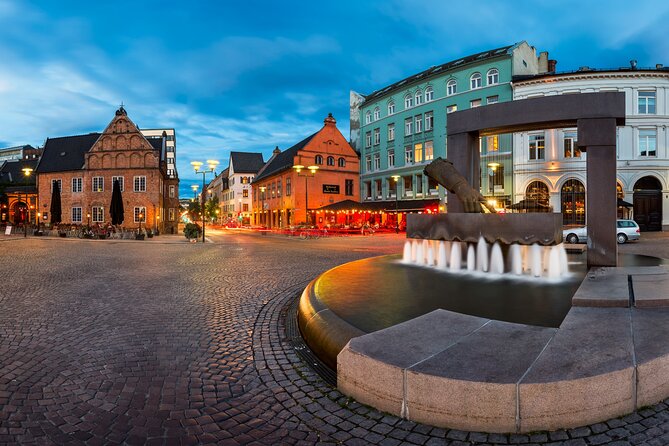
Oslo City Hall: Vikings, Beliefs, and a Worldview Outside the Doors
The tour begins at Oslo City Hall, with about 15 minutes at the start. This stop is outside only, and admission is listed as free.
Here, the emphasis is on how Vikings understood the world. That might sound abstract, but it becomes concrete when you connect beliefs to how people lived, traveled, and interpreted nature and fate. It also sets the tone for the rest of the walk, because later myths and superstition connect back to the same basic human impulse, explain what you cannot control.
If you like history that feels like a lived mindset, this opening works. It gives you a framework before you hit the more ghost-tinged stories.
Tip: arrive ready to look up and around. Even outside, Oslo City Hall and its surroundings help you orient to the area, so the next stops feel like a natural progression rather than random sightseeing.
Christiania Torv: Ghostly Apparitions and Superstition as Protection
Next is Christiania Torv, with about 20 minutes. Like the first stop, it is free to participate, and the time is focused on local folklore tied to the square and nearby streets.
The storyline here is practical in its own strange way. You learn about ghostly apparitions people claimed to see, and how locals treated superstitions as signs that could protect them from bad luck. Whether or not you believe in ghosts, you can understand why people leaned on rituals and interpretations in a less predictable world.
This is the moment where the tour shifts from broad beliefs to “how daily life handled uncertainty.” If you enjoy cultural context, you will probably like this stop a lot.
One thing to note for expectations: this is not a scary jump-scare style. It is more like eerie folklore, explained with cultural logic and a hint of humor.
Akershus Castle and Fortress: The 13th-Century Architecture That Anchors the Legends
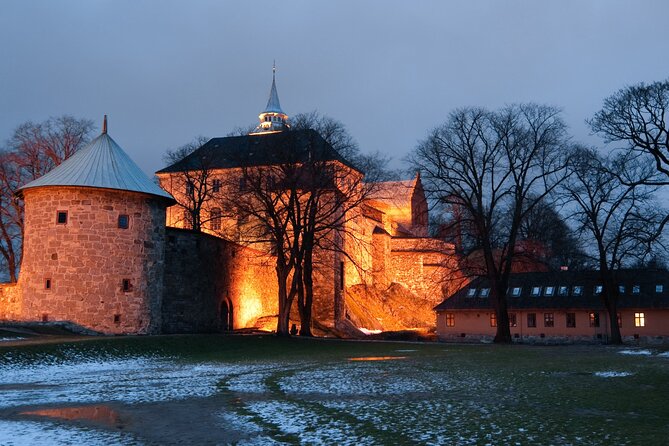
The biggest block of time is 50 minutes at Akershus Castle and Fortress. Admission is listed as free here, and this is also where the architecture does a lot of the storytelling for you.
You hear about ghosts connected to Akershus, but the real hook is the building itself. The fortress is described as having architecture that has remained unchanged since the late 13th century, which makes it feel less like a museum stop and more like a fixed point in time.
When you stand in a place like this, legends feel more believable because the setting is so strong. Even if you approach the stories as folklore, the sheer mass and age of the fortress give you that “this matters” feeling.
Practical note: because this is your longest stop, it is a good place to ask questions. The guide has time to expand, and you will have room to listen without feeling rushed.
More of Norway between waymarks, on foot:
- Taste of Oslo Walking Tour
★ 4.5 · 282 reviews - Central Oslo Guided Walking Tour with Local Guide
★ 4.5 · 278 reviews - Oslo: Private Walking Tour with a Local
★ 4.5 · 263 reviews - Oslo: Snowy Forest Torchlight Walk with Campfire
★ 4.6 · 254 reviews
Kvadraturen Neighbourhood: Medieval and Classic Oslo in One Breath
After Akershus, you head to Kvadraturen Neighbourhood for about 20 minutes. This stop is about hidden secrets in Oslo’s oldest neighbourhoods, with attention to the mix of medieval and classic architecture you can spot as you walk.
This is where the tour rewards slower attention. You do not just hear a story and move on. You get coached to look for how the built environment reflects time periods, planning, and changing tastes.
If you like your folklore tied to real places, this works well. It is also a nice breather between the fortress-heavy stop and the final cathedral moment.
Tip: bring your “street observer” mindset. You will get more out of this part if you treat it like a walking puzzle, noticing edges, styles, and street structure.
Oslo Cathedral on Stortorget: Baroque Decorations and Spires Against the Sky
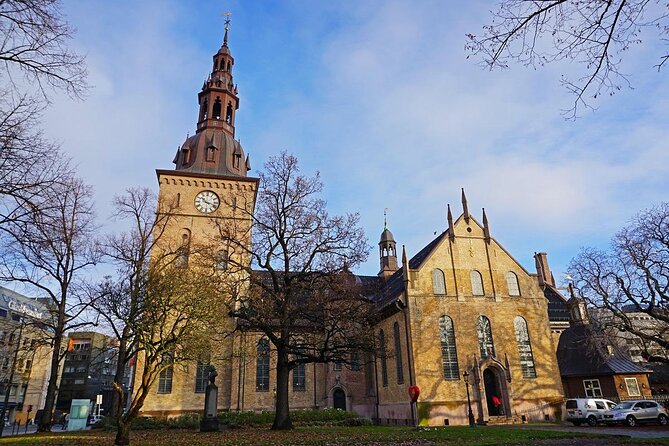
The last stop is Oslo Cathedral, with about 15 minutes. It is outside only, and it sits by Stortorget Square in central Oslo.
You learn that the cathedral dates back to 1697, and you will hear about its Baroque decorations and towering spires. This stop has a built-in wow factor because the spires give the whole area a vertical feel, even when you are standing on the square level.
The tour uses this final landmark to wrap the myth theme into something more grounded. Instead of ghosts and fear, you end with human storytelling made visible through design, religion, and community identity.
If you want a clean ending for your evening, this is a good one. The tour finishes on Karl Johans gate near Oslo Cathedral, so you naturally connect to the main pedestrian flow afterward.
Price Value: Is $42.98 Worth a Myth-Heavy Evening Walk?
At $42.98 per person, this is not the cheapest way to see Oslo on foot. But for a two-hour, English-guided tour that includes free admission listings at multiple stops, the value is about more than tickets.
You are paying for someone to translate the city for you: why these places attracted stories, how superstition shaped behavior, and how old architecture changes the way you interpret legends. When a guide can make details stick, you leave with more than photos.
Also, the small group cap of 16 travelers matters. In crowded tours, you lose part of the storytelling. Here, you are more likely to catch the nuance and keep the pacing comfortable enough to actually enjoy it.
If you are the type who likes “meaning,” not just “location,” this price starts to feel fair fast.
Who Should Book This Oslo Myth and Legends Walk?
This tour is a strong fit if you like folklore, city symbolism, and guides who tell stories with warmth and humor. The English delivery is specifically called out as a standout in feedback, and names like Marija and Ihor show up as examples of engaging narration.
It is also a good choice for couples or small groups who want an evening plan that feels different from standard sightseeing. The route is short, so it works even if you are conserving energy for the rest of your trip.
If you want a quiet, contemplative church and architecture walk with minimal storytelling, you might prefer something else. This one is built around narrative, including the ghost angle.
Should You Book This Tour?
Yes, if you want an Oslo walking experience that makes the city’s landmarks feel like characters, not just backdrops. The timed stops, free admission listings, and strong emphasis on how people used stories to make sense of uncertainty give you a tour with staying power.
Before you book, adjust your expectations if you came for a dark, scary ghost hunt. This is mystery and folklore with an approachable tone, and the best results come when you treat the stories as a window into culture and worldview.
If that sounds like your kind of evening, this is a smart way to see central Oslo while learning why the myths stuck.
FAQ
How long is Myths and Legends: An Oslo Walking Discovery?
It is about 2 hours long, with timed stops adding up to roughly that total.
What time does the tour start?
The start time is 6:00 pm.
Where do I meet the guide, and where does the tour end?
You meet at Fridtjof Nansens plass 8, 0160 Oslo, Norway. The tour ends at Stortorvet, and the final walk-on point is on Karl Johans gate near Oslo Cathedral.
Is the tour offered in English?
Yes, the tour is offered in English.
What is the price per person?
The price is $42.98 per person.
Is admission included?
Admission is listed as free for the stops included in the experience.
Are all stops indoors?
No. Oslo City Hall and Oslo Cathedral are outside only, while the Akershus Castle and Fortress stop includes free admission and has a longer time allocation.
What group size should I expect?
The tour has a maximum of 16 travelers.
Can I cancel for a full refund?
You can cancel up to 24 hours in advance for a full refund. If you cancel less than 24 hours before the experience starts, the amount paid is not refunded.
Newly marked on the map for Oslo
- Oslo Scavenger Hunt and Highlights Self Guided Audio Tour★ 4.5 · 6 reviews
- Oslo easy walk★ 5.0 · 7 reviews
- Oslo: Oslofjord Electric Boat Cookie Cruise★ 3.8 · 7 reviews
- Oslo City Walks: The City of Contrasts★ 3.4 · 7 reviews
- The Oslo Beer Adventure★ 1.9 · 7 reviews
- 7-Day Scenic Scandinavian Tour from Oslo exploring Denmark, Sweden and fjords in Norway★ 4.5 · 7 reviews
- Private Oslofjord Island Hopping Tour★ 4.5 · 8 reviews
- Free Oslo Photo Tour: Iconic & Instagrammable Spots★ 5.0 · 8 reviews
Guided Walks in Oslo, compared.

Guided Walking Tour of Central Oslo with Local Guide
Read our review →



Central Oslo Guided Walking Tour with Local Guide
Read our review →


Browse the lists this tour appears in