
Reviewed · CITY TOURS IN OSLO
Oslo city center Tour
Oslo tells stories at walking speed. This 2 to 2.5 hour city center route strings together royal sights, Nobel Peace Prize connections, World War II resistance lore, and fjord-side modern culture.
I love the small group feel (max 15) and the way the guides, like Nahuel and Eleonora from Itatina, keep the pace friendly and question-friendly. I also like that you are not just staring at buildings, you get short stops packed with photo spots and fun facts. One drawback to plan around: many stops are intentionally brief, so if you want long interior time, you may feel a bit rushed, and the tour needs good weather.
In This Review
- Key highlights worth your attention
- How this Oslo city center walk saves you time
- Meeting point at Karl Johan Monument, then straight into the highlights
- Royal Palace stop: elegant architecture and royal stories, no inside required
- University Square: neoclassical campus energy and a Nobel Peace Prize connection
- Gunnar Sønsteby statue: WWII resistance told in one powerful place
- Nationaltheatret: when architecture meets Norwegian drama
- Rådhusplassen and Oslo City Hall: Nobel Peace Prize awarded here
- Akershus Castle and Fortress: medieval walls with harbor views
- Bankplassen: the quiet square where old life hid in plain sight
- Bjørvika: modern Oslo with Munch links, the Opera House area, and Deichman Library
- Jernbanetorget and the tiger sculpture: main station energy in one iconic spot
- Oslo Cathedral finish: a strong ending point for continued exploring
- Price and value: what $53.65 buys you in real terms
- Pacing, group size, and who this walk suits best
- Weather, timing, and planning your Oslo day
- Should you book this Oslo city center tour?
- FAQ
- How long is the Oslo city center tour?
- Is the tour in English?
- What is the starting point of the tour?
- Where does the tour end?
- How large is the group?
- Is a mobile ticket provided?
- Are admission tickets included for the stops?
- What is the price per person?
- Does the tour depend on weather?
- Is free cancellation available?
Key highlights worth your attention
- Royal Palace photos without the inside rush
- University Square tie-in to a Nobel Peace Prize ceremony
- Gunnar Sønsteby statue, one of Norway most decorated war heroes
- Nobel Peace Prize at Rådhusplassen, Oslo City Hall
- Bjørvika mix of art, the opera house area, and Deichman Library
- Jernbanetorget tiger sculpture, great for an easy start feel
How this Oslo city center walk saves you time
This is a smart pick when you want to get oriented fast, without trying to cram everything into one chaotic day. The route is designed for high value per minute, linking major landmarks in the center so you can connect the dots between power, culture, and everyday Oslo life.
You also get a smooth flow of stops, mostly in the 10 to 20 minute range. That matters because Oslo can be wonderfully walkable but also a place where a long detour can eat your afternoon. Here, the tour keeps momentum, then hands you an end point at a classic spot to continue on your own.
Meeting point at Karl Johan Monument, then straight into the highlights
The tour begins at the Karl Johan Monument in Sentrum. It is a central starting point, which is exactly what you want on day one, because you can arrive using public transportation and still feel like you are part of the city right away.
From there, you move through a sequence of landmarks that show off Oslo in two modes. First, the official side: royals, theaters, institutions. Then, the modern side: the fjord view zone around Bjørvika, plus art-forward details near the main station.
If you like structure, this tour gives it to you. If you like flexibility, it also helps because you will finish close enough to keep wandering without a long travel gap.
More City Tours in Oslo



Royal Palace stop: elegant architecture and royal stories, no inside required
At the first stop, you will spend about 10 minutes at the Royal Palace area. The key point: the tour includes a ticket, but you are not going inside. That works for most first-time visitors, because the exterior is the big draw, and the guide stories help you see the building as more than just a pretty facade.
You will also get historical context about the Norwegian royal family and their role today, plus fun, photo-friendly angles. Even without entering, this stop gives you an early sense of how Oslo frames authority and tradition in plain sight.
Tip for your photos: spend your short time lining up a clean front view, then grab one side angle. With limited minutes, doing two quick angles beats hoping you get a third later.
University Square: neoclassical campus energy and a Nobel Peace Prize connection
The next stop is University Square, with around 15 minutes to look around. This is where you learn that the University of Oslo is Norways oldest and one of its most prestigious institutions, and the guide connects the architecture to that academic identity.
What makes this stop especially interesting is the Nobel Peace Prize tie-in. You will hear how the location once hosted a Nobel Peace Prize ceremony. That is not just trivia, it helps you understand why Oslo treats education, public events, and global recognition as part of the same story.
If you enjoy civic narratives, this is a good midpoint. You start with monarchy, then pivot to institutions, and suddenly Nobel is not a random museum topic. It becomes part of the city center map.
Gunnar Sønsteby statue: WWII resistance told in one powerful place
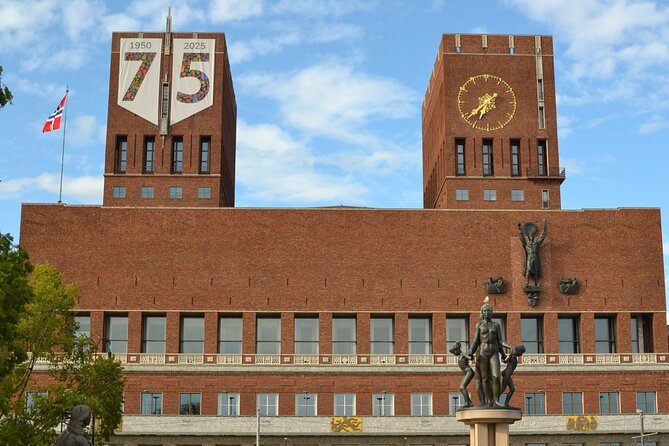
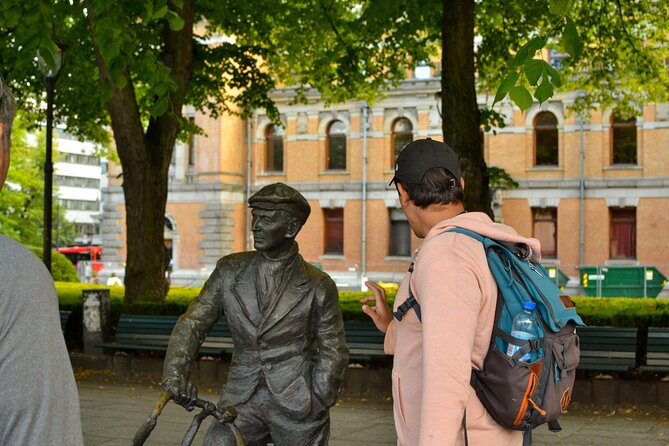
Around 15 minutes brings you to the Gunnar Sønsteby statue. If you want one stop that turns your walk into something more meaningful, this is it.
You learn about Gunnar Sønsteby, described as Norways most decorated war hero, and his resistance against Nazi occupation during World War II. The guide explains the courage and clever tactics behind the story, then links his legacy to Norwegian freedom and resistance.
This is also a great photo pause because statues give you a fixed background. When time is short, fixed points are easier to capture. It is the kind of stop where you might notice people slow down and listen even if they did not plan to.
Where the path branches next in Oslo
- Oslo: Oslo Fjord Sightseeing Cruise by Sailing Ship
★ 4.5 · 5,790 reviews - Oslo: Scenic Fjord Cruise with Audio Guide Commentary
★ 4.5 · 5,375 reviews - Oslo Nature Walks: Island Hopping Tour
★ 4.8 · 2,713 reviews - Oslo: 24 or 48-Hour Hop-On Hop-Off Sightseeing Bus GrayLine
★ 4.0 · 2,088 reviews
Nationaltheatret: when architecture meets Norwegian drama
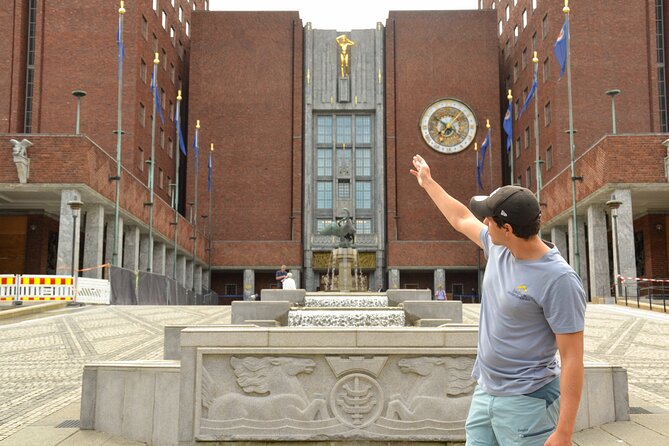
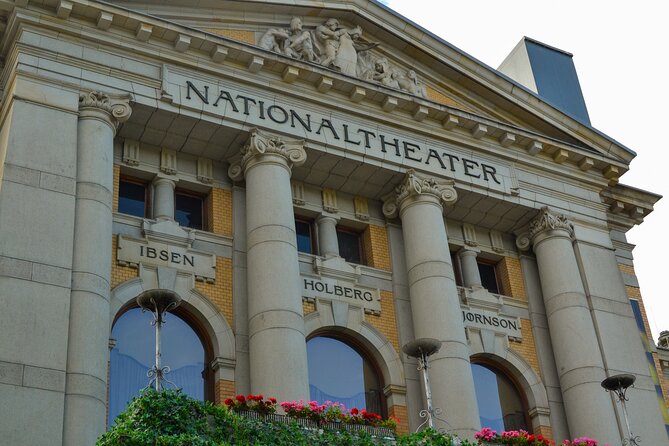
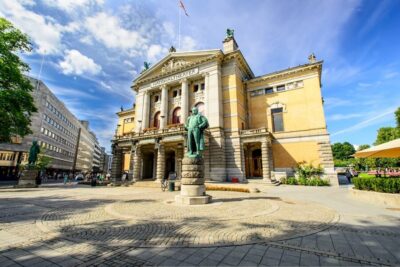
Next is Nationaltheatret, about 15 minutes. This is one of those Oslo landmarks that feels like it belongs on a postcard, yet it is also deeply tied to real cultural life.
The guide covers the theater building and its history, and you will hear about playwrights honored there, especially Henrik Ibsen. The payoff is that you stop seeing Norwegian culture as distant textbook stuff. You see how the city physically places drama at the center of daily routes.
Because this is a brief stop, keep your eyes moving. Look at the facade details first, then listen to the guide, then return to the building for one last photo when your understanding has clicked.
Rådhusplassen and Oslo City Hall: Nobel Peace Prize awarded here
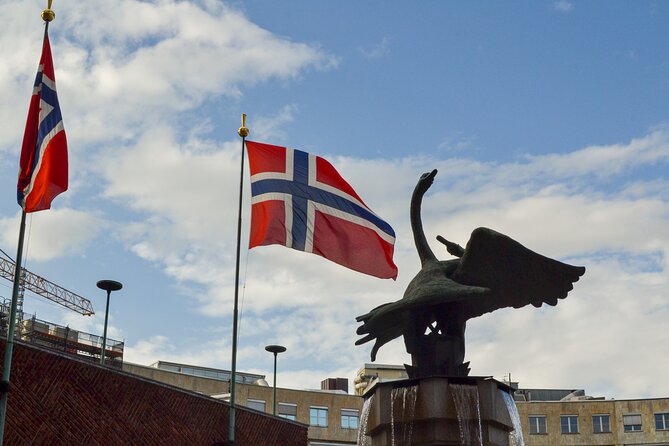
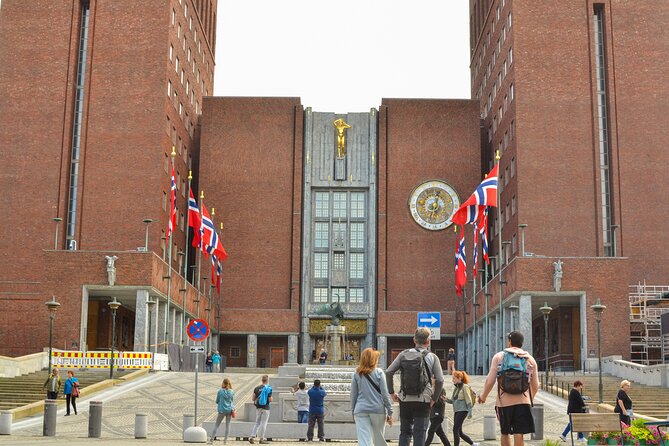
Then you head to Rådhusplassen for about 15 minutes. This stop is about Oslo City Hall, where the Nobel Peace Prize is awarded each year. The guide also points out architecture and murals, with stories tied to Norwegian history, culture, and everyday life.
Even if you do not plan to visit the Nobel museums right away, this is a useful context anchor. You learn how Oslo turns a global symbol into a local civic landmark, right in the city center.
For a practical benefit, this stop also helps you pace your day. After palace and war-story gravitas, City Hall can feel like a calmer, more public space, and the murals give you something to study without needing to rush.
Akershus Castle and Fortress: medieval walls with harbor views
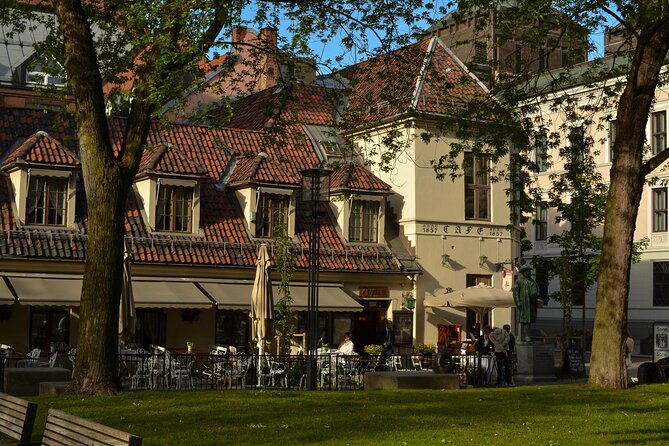
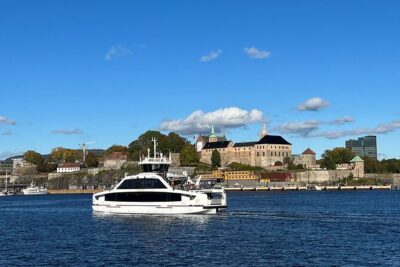
The Akershus Castle and Fortress stop is longer than most, at about 20 minutes. You explore Oslo historic core with a view of Akershus, a medieval fortress overlooking the harbor.
The guide connects the site to city protection and royal residence. That combination matters because it explains why this area feels both military and ceremonial, which is exactly what you will notice in the structure and surrounding atmosphere.
Right nearby, you also visit Christiania Torv, an old town square connected to King Christian IV and the decision to rebuild Oslo after the 1624 fire. This pairing is smart because you get both the defensive “outside” story and the rebuilding “inside” story without backtracking.
Bankplassen: the quiet square where old life hid in plain sight
At Bankplassen you get about 10 minutes. This stop is free of admission and often the one I think people underestimate.
You step into a square with layered stories, including that the area once held the citys first restaurant, an early theater, and even an orphanage. That mix of food, performance, and care changes how you read the buildings around you. You start noticing that a city center is not only monuments, it is also routines and small lives.
Even if you only get one short loop around the square, it helps you shift from big landmarks to human-scale history.
Bjørvika: modern Oslo with Munch links, the Opera House area, and Deichman Library
Bjørvika is the tours modern turn, and it is timed for about 10 minutes. You get sweeping views toward Ekeberg Park, plus a look in the direction of the Munch Museum area and the Oslo Opera House.
The guide also highlights Deichman Library as an innovative cultural hub of knowledge and design. And since Oslo loves art in public places, you are told not to miss a unique floating sculpture in the fjord that signals the citys creative spirit blending art with nature.
This is a “see it fast, remember it later” stop. Bjørvika is so photogenic that a quick pass can still be satisfying, as long as you look up and out as well as at the buildings.
Jernbanetorget and the tiger sculpture: main station energy in one iconic spot
Next comes Jernbanetorget, about 15 minutes. This square is famous for the tiger sculpture, and it is right at Oslo Central Station area, which means you get real city energy around you.
Even though this is a short stop, it is valuable because it is not just history. It is the place locals and travelers cross through, which makes the “Oslo feel” part of the day.
If you want a practical takeaway, this stop helps you understand where you can base your own exploring later. After the tour, your feet already know how to orient in the busiest central hub.
Oslo Cathedral finish: a strong ending point for continued exploring
You end at Oslo Cathedral, also called Oslo Domkirke. The tour includes about 10 minutes here, with admission included, and it is the perfect place to pause before you keep walking on your own.
This cathedral is presented as a majestic cultural landmark, with history, architecture, and spiritual significance. Even if your time is short, you can still appreciate the facade details and, if you choose, the peaceful atmosphere inside.
Finishing at a cathedral works because it gives you a “close” to the tour theme. You start with power and institutions, you pass through culture and civic landmarks, then you finish with something that feels centered and reflective.
Price and value: what $53.65 buys you in real terms
At $53.65 per person, you are paying for a guided route that bundles multiple landmark areas and, importantly, includes tickets for many of the stops. Several key pauses list admission included, while others are free, so the money is not only about commentary. You also get access support where it is part of the experience format.
You are also buying time efficiency. With a 2 to 2.5 hour duration and a tight center loop, you can cover a lot of the “first Oslo day” checklist without spending your energy figuring out sequencing.
Small group size, mobile ticket delivery, and English language also add value. Guides like Nahuel and Eleonora come through in the reviews for being active and communicative, plus for giving additional suggestions at the end, including places for museums, hiking, and food. That kind of follow-on advice can easily stretch the value of a short tour into a full day.
Pacing, group size, and who this walk suits best
The max group size of 15 matters more than you might think. Smaller groups usually mean you can ask questions and still keep moving, which is especially helpful on a walking route where the city does not pause.
The tour also seems to work well for different ages. One review mentioned that the pace was ideal for people in their 60s, which suggests the stops are planned to avoid pushing too hard.
This tour is a strong fit if you:
- want a first-time introduction to Oslo city center
- like architecture plus story, not just photos
- prefer a structured walk with short but meaningful stops
It may feel less ideal if you:
- want long interior visits at multiple buildings
- get annoyed when every stop is timed tightly
- need a lot of free time to roam without guidance
Weather, timing, and planning your Oslo day
The experience runs at 10:00 am and is best treated like an outdoor walking tour that depends on conditions. The requirement for good weather is not a minor note. Rain, cold wind, or poor visibility can make the walking parts less pleasant, and the schedule is built around seeing a lot in a short window.
Booking timing can also matter. On average, people book this tour about 35 days in advance, which hints it stays popular for the “intro Oslo” slot. If you have fixed travel days, I would plan early rather than gamble on availability.
Should you book this Oslo city center tour?
Yes, if you want an efficient, story-driven introduction to the city with a clear route and a friendly small group. The mix is genuinely well judged: royal architecture, Nobel connections, WWII resistance, major cultural institutions, harbor fortress views, then a modern Bjørvika snapshot and a practical finish at Oslo Cathedral.
I would skip it only if you know you want deep time inside buildings or you prefer an unstructured walk with no timed stop format. Otherwise, this is exactly the kind of city center tour that helps you enjoy Oslo faster, with fewer guesswork moments.
FAQ
How long is the Oslo city center tour?
It runs about 2 hours to 2 hours 30 minutes.
Is the tour in English?
Yes, it is offered in English.
What is the starting point of the tour?
The tour starts at Karl Johan Monument in Sentrum, Oslo.
Where does the tour end?
The tour ends at Oslo Cathedral on Karl Johans gt. 11.
How large is the group?
The maximum group size is 15 travelers.
Is a mobile ticket provided?
Yes, the tour uses a mobile ticket.
Are admission tickets included for the stops?
Admission tickets are included for several stops in the route, while some stops are listed as free.
What is the price per person?
The price is $53.65 per person.
Does the tour depend on weather?
Yes. The tour requires good weather. If it is canceled due to poor weather, you will be offered a different date or a full refund.
Is free cancellation available?
Yes. You can cancel for a full refund up to 24 hours in advance.
Newly marked on the map for Oslo
- Oslo Scavenger Hunt and Highlights Self Guided Audio Tour★ 4.5 · 6 reviews
- Oslo easy walk★ 5.0 · 7 reviews
- Oslo: Oslofjord Electric Boat Cookie Cruise★ 3.8 · 7 reviews
- Oslo City Walks: The City of Contrasts★ 3.4 · 7 reviews
- The Oslo Beer Adventure★ 1.9 · 7 reviews
- 7-Day Scenic Scandinavian Tour from Oslo exploring Denmark, Sweden and fjords in Norway★ 4.5 · 7 reviews
- Private Oslofjord Island Hopping Tour★ 4.5 · 8 reviews
- Free Oslo Photo Tour: Iconic & Instagrammable Spots★ 5.0 · 8 reviews
City Tours in Oslo, compared.

Grand City Sightseeing Tour by Bus with Fjord Cruise
Read our review →
Oslo Combo Tour: Grand City Tour and Oslo Fjord Cruise
Read our review →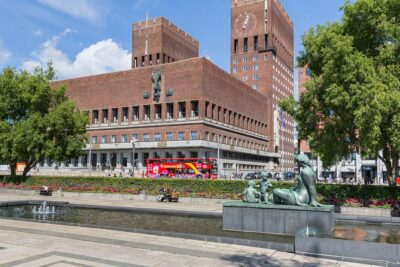

Oslo Shore Excursion: City Sightseeing Oslo Hop-On Hop-Off Bus Tour
Read our review →Browse the lists this tour appears in